A conversation with Dr. Paula Zook — Spectrum Dermatology of Seattle
Skin cancers are highly curable when caught early — which makes consistent monitoring and good sun habits among the most valuable investments in your long-term health. Dr. Zook shares what she tells patients every day.
Dr. Zook
At-home monitoring is a wonderful habit, but nothing replaces a comprehensive exam with a board-certified dermatologist. Every day at Spectrum Dermatology we diagnose skin conditions and skin cancer, provide education, and perform thorough preventative screenings. A baseline exam lets us understand your unique risk factors and create a personalized, lasting approach to your skin health.
Key point: A baseline exam establishes your personal benchmark — so any future changes are caught early, when treatment is most effective.
Dr. Zook
Absolutely — and I encourage every one of my patients to do it. A monthly self-exam is one of the most powerful tools you have, because you know your own skin better than anyone. Here's how I recommend approaching it: Start in a well-lit room with a full-length mirror and a hand mirror for hard-to-see areas. Begin at the top — your scalp (use a comb or hair dryer to part your hair), face, ears, and neck. Move down to your chest, abdomen, and both sides of your arms, including your underarms and the backs of your hands. Then check your lower body — front and back of your legs, between your toes, and the soles of your feet. Use your hand mirror to examine your back, buttocks, and the back of your neck. What are you looking for? Anything new, anything changing, and anything that just looks different from everything else on your skin. Use the ABCDE guide — Asymmetry, irregular Borders, uneven Color, a Diameter larger than a pencil eraser, and anything Evolving or new. A spot that itches, bleeds, crusts, or simply won't heal also deserves attention. Self-exams are a wonderful complement to professional care — but they are not a replacement. If anything catches your eye, don't wait. Come see us.
Dr. Zook's rule: Anything new, changing, or unusual deserves a professional opinion. When in doubt, come in — early detection is everything.
Dr. Zook
This is one of the most important questions I hear, because there's a widespread and dangerous myth that people with darker skin tones don't get skin cancer. They absolutely do — and because of lower awareness, it's often diagnosed at a much later, harder-to-treat stage. For melanoma, here's what to watch for: use the ABCDE guide — Asymmetry, irregular Borders, uneven Color, a Diameter larger than a pencil eraser, and anything Evolving or changing, including new. Also watch for a dark streak or band under a fingernail or toenail, a sore that won't heal, or any bump or patch that looks different from the skin around it. In people with darker skin tones, melanoma most commonly appears in areas that rarely see the sun — the palms of the hands, soles of the feet, under and around the nails, and in the mouth. These are spots many people never think to check. I'd encourage you not to wait for something to look "serious" before coming in. If something is new, changing, or just feels off, let us take a look.
Where to check: Palms, soles of feet, nail beds, and the mouth are the highest-risk sites for melanoma in people with darker skin — areas easy to overlook in a self-exam.
But the most common type of skin cancer in persons with darker skin is squamous cell carcinoma, so it’s important to know what to watch for with these as well. Look for a firm red, purple, black or brown lump that may be tender, a scaly patch, a wart-like growth, or a rough patch that may become an open, non-healing sore. Pay special attention to chronic scars, lower extremities, genitals and the scalp. Squamous cell cancer can be serious if not caught early, so if you are concerned, get checked.
Dr. Zook
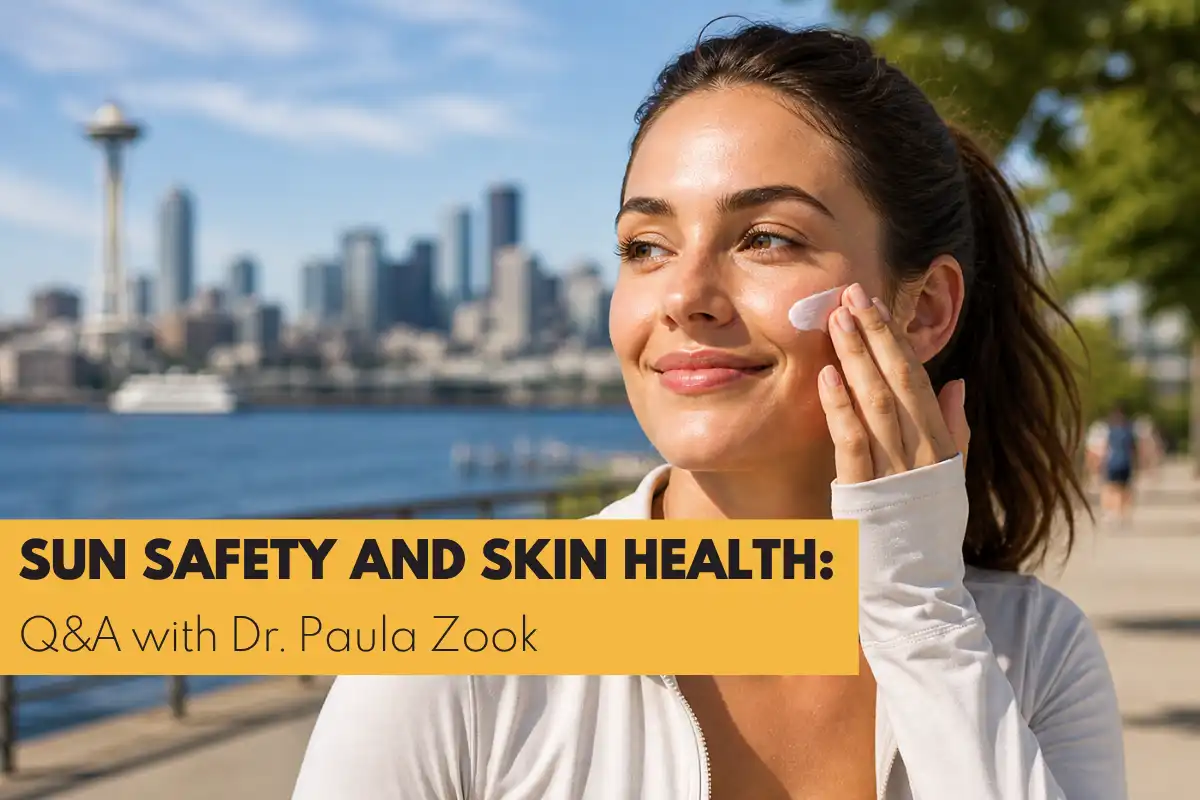
This is something I feel strongly about, because the Pacific Northwest has a blind spot when it comes to skin cancer risk. Washington state ranks among the highest in the
country for melanoma rates — higher than many southern or sunbelt states — and I believe one reason is complacency born from cloudy skies. People step outside on an overcast Seattle day and simply don't think about sunscreen. But up to 80% of UV radiation passes right through cloud cover, and cumulative daily exposure — walking to the car, eating lunch outside, a weekend hike — adds up quietly over years. Beyond that, I see several daily habits that significantly elevate risk for my patients: skipping SPF because it feels unnecessary in our climate; using tanning beds during our long grey winters; and getting intense, unprotected UV exposure on vacations to sunny destinations. Reflective surfaces here also amplify risk in ways people don't anticipate — our beautiful lakes, mountain snow, even concrete can bounce UV back onto your skin. Genetics and family history play a significant role too. And finally, the outdoor lifestyle we love — hiking, skiing, kayaking — is wonderful, but it means extended UV exposure often without adequate protection. I tell my patients: living in the Northwest doesn't protect you. It just hides the risk.
PNW reality check: Washington state has higher melanoma rates than many sunbelt states — largely because cloud cover creates a false sense of safety. Daily SPF is non-negotiable, even in January.
Dr. Zook
UVA rays are longer wavelengths responsible for photoaging — they break down collagen, causing wrinkles and thinning skin, and play a significant role in melanoma development. UVB rays are shorter, higher-energy wavelengths that cause painful sunburns and drive most skin carcinogenesis. Defending against both requires a broad-spectrum approach.
Remember: Think A for Aging, B for Burning — and protect against both with every sunscreen application.
Dr. Zook
I recommend building a "sunscreen wardrobe" — a range of products so you always have one that feels comfortable enough to wear every day. Look for mineral-based formulas with zinc oxide at 10% or greater as the primary active ingredient; it offers the most comprehensive UVA protection available. SPF 30 or higher, applied generously. At our clinic
we carry over 45 mineral sunscreens from medical-grade lines like EltaMD and Epionce to help you find your perfect match.
Pro tip: The best sunscreen is the one you'll actually use consistently — don't settle for a formula that you don’t like. Try some until you find ones you feel comfortable with.
Dr. Zook
Absolutely. Physical barriers — hats, sunglasses, UPF clothing — are your first line of defense. Seek shade. Limit time in direct sun, especially during the middle of the day. Beyond that, you can support your skin from the inside out. We offer clinical-grade antioxidant supplements like Sunisdin and Heliocare, which help neutralize free radical damage and have been shown to reduce skin cancer risk as well as visible signs of sun damage. And for our Seattle coffee lovers: studies show caffeinated coffee consumption is associated with a reduced risk of certain skin cancers.
Did you know: Layering multiple strategies — topical, physical, and nutritional — gives your skin the strongest, most comprehensive protection.
Dr. Zook
It's a genuinely exciting time in dermatology. Some of the most meaningful progress has been in immunotherapy — treatments that harness the body's own immune system to fight melanoma. Checkpoint inhibitors like pembrolizumab and nivolumab have shown remarkable results, and recent trials found that using these drugs both before and after surgery significantly reduced the risk of cancer returning compared to post-surgery treatment alone. On the detection side, AI-assisted tools can now analyze dermoscopy images with accuracy nearly comparable to experienced dermatologists, and track changes in moles. We're seeing science move faster than ever, which makes staying current through a relationship with your dermatologist more valuable than ever. I love the opportunities at annual skin checks to educate patients on the latest in skin cancer protection and detection.
What this means for you: Earlier detection and smarter treatments are translating into better outcomes — another reason regular professional screenings are so worthwhile.
Dr. Zook
Protecting your skin is a lifelong journey, and there's no shame in recognizing when a habit — like using tanning beds or skipping SPF — needs adjusting. Our team is here to support you with gentle, effective strategies to build healthier routines without judgment. Every positive change, no matter how small, genuinely matters. At Spectrum Dermatology of Seattle, we’re eager to support you in your journey.